
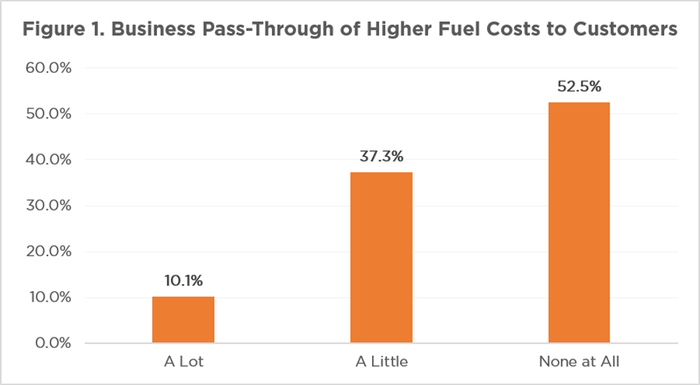
More than half of Tennessee business leaders absorbed higher fuel costs rather than passing them on to customers, according to a new survey by the Boyd Center for Business and Economic Research at the University of Tennessee, Knoxville, Haslam College of Business. The survey overall shows continued optimism about Tennessee’s economy, despite a bleaker national outlook and increased sensitivity to global political instability.
In the summer 2026 Tennessee Business Leaders Survey, administered in August, more than 47 percent of employers said they had raised prices to offset rising gas and diesel costs. One in 10 said they were passing a lot of the increased costs on to their customers.
Don Bruce, Boyd Distinguished Professor and director of the Boyd Center, said the August results reflect continued pressure from volatility in oil prices.
“Oil market instability continues to strain our state’s businesses and their bottom lines,” said Bruce. “These August results show that business leaders are trying to cushion the blow to consumers, but absorbing those costs will become harder.”
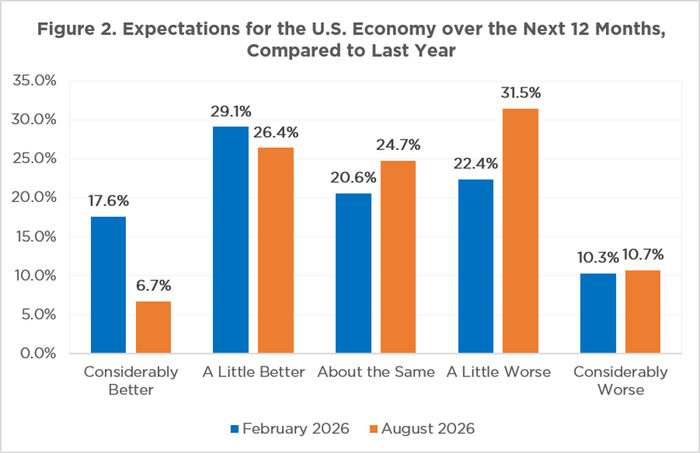
Four in five business leaders surveyed put the chance of a recession in the coming year at below 50 percent. That rate is consistent with the winter survey, which was conducted in February. Still, pessimism about the national economy is increasing. Almost 45 percent said the economy was somewhat or considerably worse than a year ago, up from 37.6 percent in February. The share of business leaders expecting the national economy to worsen over the next year rose nearly 10 percentage points, from 32.7 percent in February to 42.1 percent.
Though confidence in the state’s economy has declined since February, 57.2 percent of the business leaders surveyed said they still expected Tennessee’s economy to outperform the nations, and almost two-thirds said Tennessee was on the right track. Asked about the reasons behind their responses, 48.2 percent credited business investment in Tennessee and 24.8 percent listed government leadership in the state. Three in five respondents rated the business environment in Tennessee as good or excellent, but areas for improvement included developing infrastructure and enhancing workforce development.
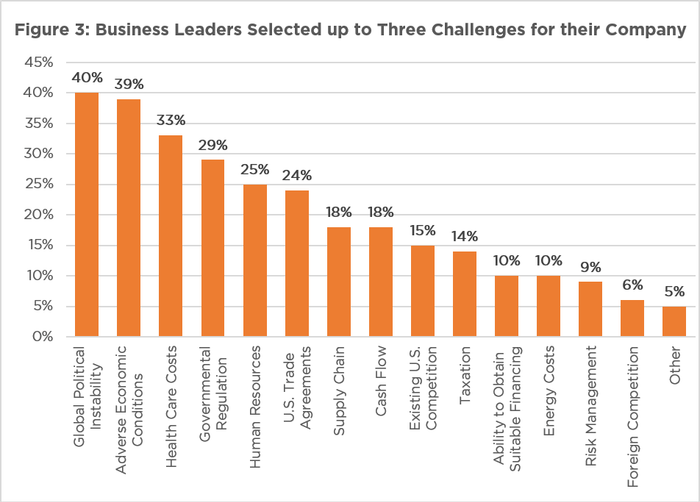
For the first time, 40 percent of respondents ranked global political instability as one of their top three business concerns. Other top concerns included adverse economic conditions (39 percent) and healthcare costs (33 percent).
A little over half (56.8 percent) of employers surveyed reported an insufficient supply of appropriately trained workers in the state labor force. About 61 percent identified work ethic as the most frequently missing attribute among job applicants. In West Tennessee, work ethic was overwhelmingly the top issue, with 85 percent of employers listing it. Statewide, employers also identified initiative (44.4 percent), realistic compensation expectations (43.8 percent) and technical skills (40.1 percent) among their concerns.
The employers surveyed said they were increasingly using AI in a way that doesn’t affect hiring levels. Almost 72 percent said AI hadn’t affected their employment levels, an increase of almost 10 percentage points since the winter survey. About 10 percent reported hiring fewer employees due to AI, and just 16.3 percent said they are not using AI in any capacity — down from a quarter of respondents in February.
The share of business leaders citing problems attracting and retaining employees increased from 36.8 percent in February to 43.5 percent. The issue appears to be less acute among employers in Middle Tennessee, with only a quarter of respondents reporting it as a problem for their business. Nearly three in five of all employers surveyed attributed the challenge to the cost of housing, though many cited the cost of childcare (37.9 percent) and availability of housing (30.4 percent) as well.
The full set of survey responses is available on the Boyd Center website.
The Boyd Center, part of UT’s Haslam College of Business, surveyed business leaders across Tennessee between August 5 and August 28. Respondents represented a broad sample of businesses across all industries, ranging in size from fewer than 50 employees to more than 5,000.
—
Author:
Erin Hatfield, Boyd Center communications and events specialist; 865-974-6086, [email protected]
Contact

Related News
UT Haslam Faculty Finds Tennessee’s Free Community College Expands Opportunity without Breaking Budgets
By its own stated objectives, the Tennessee Promise Act has been successful... and it's provided a model for comparable programs...
Read ArticleUT Haslam Faculty Study the Economics of Education
Experts weigh in on college affordability and the role of technology.
Read ArticleTwo UT Boyd Center Faculty Leading Top Economics of Education Journals
Celeste Carruthers is the editor-in-chief at the Economics of Education Review, while Mike Kofoed is a co-editor for the Education...
Read ArticleUT Haslam Honors Staff, Faculty and Students at Annual Awards Ceremony
College leadership handed out 24 awards to the Haslam community.
Read Article