
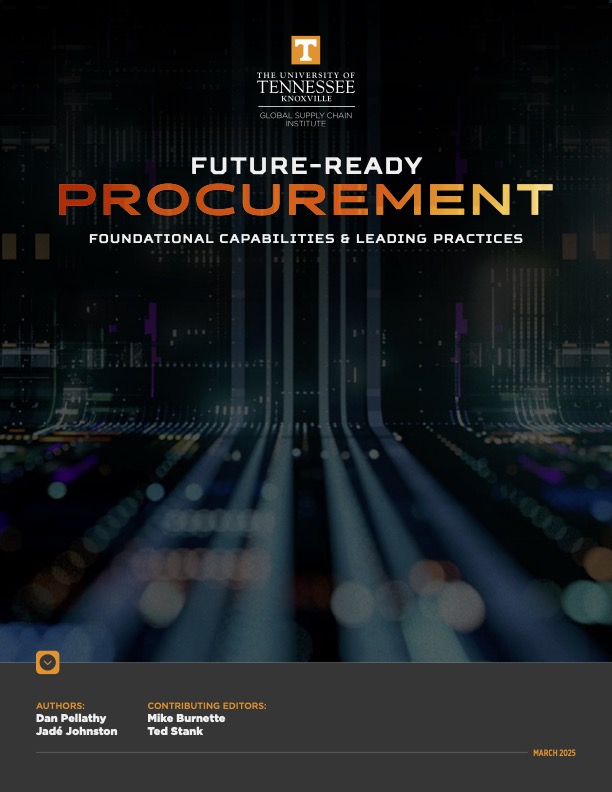
Future-Ready Procurement: Foundational Capabilities & Leading Practices
Publication Date: April 9, 2025
Topics: ASCC, Strategy, Talent Development
Building Future-Ready Procurement Capabilities
A Framework for Supply Chain Procurement Transformation
A White Paper by the University of Tennessee Global Supply Chain Institute
What’s Inside
Future-ready procurement demands a fundamental shift from cost reduction and transactional relationships to strategic value creation. Most procurement teams were built for a different era—one defined by relatively stable supply chains and a narrow focus on savings. Today, supply chain disruptions, ESG mandates, geopolitical volatility, and the rapid rise of AI are fundamentally changing what procurement teams must be able to do. Yet procurement remains disconnected from broader supply chain and customer-led decisions, too often engaged only after decisions have been made—forcing teams to react rather than lead. The question is not whether to transform; it is how, and how quickly.
In “Future-Ready Procurement: Foundational Capabilities & Leading Practices,” researchers Dan Pellathy from the University of Tennessee’s Global Supply Chain Institute (GSCI) and Jadé Johnston of Leidos draw on original research with leading Advanced Supply Chain Collaborative (ASCC) partner companies to define what future-ready procurement looks like and what it takes to build it. Based on engagements with senior procurement leaders across industries, including pharmaceuticals, consumer packaged goods, aerospace, and industrial manufacturing, the research identifies three foundational capabilities every procurement team must develop: customer value management, talent pipeline management, and cross-functional integration.
Because transformation requires more than frameworks, the paper also outlines five major opportunity areas where procurement leaders can begin taking action today: organizational design, knowledge sharing and organizational learning, indirect spend optimization, environmental/social/governance (ESG) integration, and redefining risk. Each area is supported by real-world case studies from leading companies—including examples of procurement teams that reduced lead times by a third, realized upwards of $500 million in savings through cross-functional finance partnerships, and cut Scope 1, 2, and 3 emissions through supplier collaboration.
Beyond foundational capabilities, the research introduces a balanced scorecard approach to categorizing future-ready procurement capabilities across four areas: Partnership Excellence, Operational Excellence, Continuous Improvement, and Value Innovation. These capability areas help procurement teams move from “best practices” to “best fit,” calibrating investments based on their specific business sourcing models—from basic transactional providers to vested and equity partnerships. The paper draws on the seven business sourcing models developed by University of Tennessee researcher Kate Vitasek and colleagues to guide this alignment.
This white paper equips procurement and supply chain leaders with a practical, research-backed roadmap for building future-ready procurement teams—including a comprehensive list of capability definitions and a capability gap assessment tool—to transform procurement from a cost center into a strategic driver of customer value, competitive differentiation, and organizational growth.
Download to Explore
- Why traditional procurement approaches are failing, and what the cost of inaction looks like
- The three foundational capabilities every future-ready procurement team must build
- Five major opportunity areas for procurement transformation
- A balanced scorecard of future-oriented procurement capabilities across Partnership Excellence, Operational Excellence, Continuous Improvement, and Value Innovation
- How to align procurement capabilities with business sourcing models
- Real-world case studies from companies pioneering the future of procurement
- A comprehensive capability definitions list and gap assessment tool
- Recommendations for measuring the ROI of capability investments
Who This White Paper Is For
This white paper is designed for:
- Chief Procurement Officers and Supply Chain Leaders
- Corporate CEOs and Chief Supply Chain Officers
- Supply Chain Managers and Planners
- Procurement Professionals and Strategic Sourcing Teams
- Supply Chain Professionals and Advanced Students
For more in‑depth, industry‑focused white papers from the Global Supply Chain Institute (GSCI) at the University of Tennessee, Knoxville, visit our white papers library. Recent research produced by the Advanced Supply Chain Collaborative (ASCC) engages industry leaders and UT faculty to explore and report on leading‑edge practices in supply chain management, planning, and innovation.