

Neel Corporate Governance Center
RESEARCH COLLABORATIONS
The Neel Corporate Governance Center has a rich history of collaborating with practitioners to conduct research that advances understanding of corporate governance. Past collaborations have produced research that offers valuable insights into corporate governance practices and challenges.
Neel Center and the Center for Audit Quality
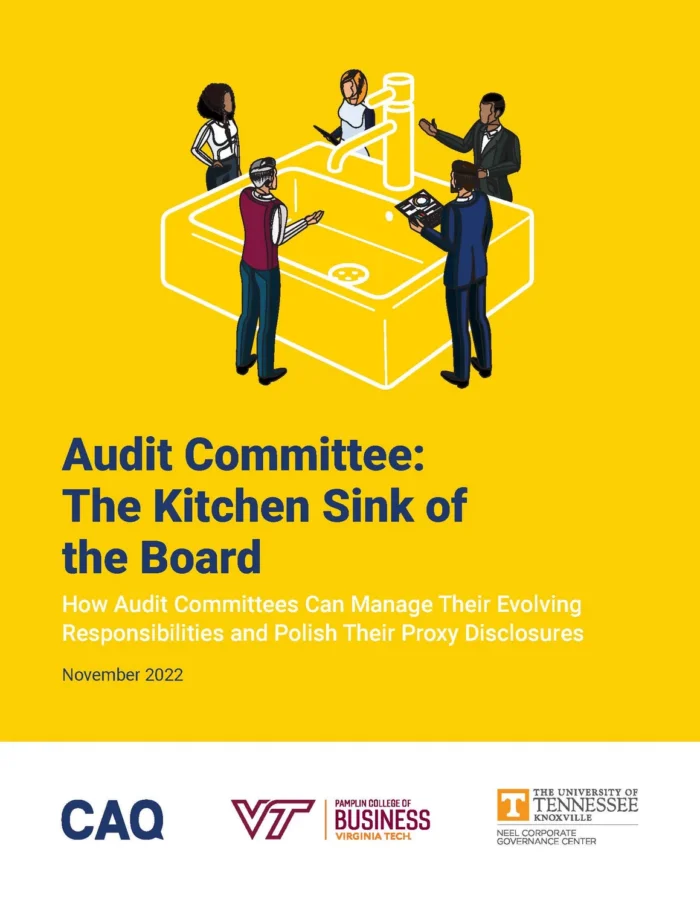
“Audit Committee: The Kitchen Sink of the Board, 2022“
The role of the audit committee (AC) has changed significantly since the passage of the Sarbanes-Oxley Act of 2002; many ACs now oversee a variety of emerging risks and balance an ever-increasing workload. To understand more about ACs’ evolving responsibilities, proxy disclosure strategies and self-evaluation processes, researchers interviewed AC chairs or members from a variety of industries, company sizes and maturity levels, as well as members of the investor community and those charged with preparing proxy disclosures to learn how ACs can better communicate their oversight responsibilities.
The following leading practices related to three questions of current interest to ACs and their stakeholders were collectively gleaned from these interviews:
- How can boards effectively allocate oversight responsibilities to the AC?
- How can AC members keep up with an ever-evolving workload?
- How can ACs improve their disclosures related to AC oversight responsibilities?

Neel Center and The Institute of Internal Auditors
“American Corporate Governance Index: Grappling with the Fatigue Factor, 2021“
As the toxic effects of a global pandemic continued to stubbornly linger and the fallout from 18 months of business, economic and social disruption manifested in varied ways, data from the 2021 American Corporate Governance Index (ACGI) survey pointed to signs of fatigue as governance improvements seen in 2020 slowed or stagnated across a number of areas examined.
This slowdown was understandable, if not anticipated. Indeed, governance gains made amid the chaos of COVID-19’s initial onslaught highlighted commendable resilience among publicly traded companies and provided one of the few bright spots in an otherwise distressing year. However, those initial successes gave way to potential slips and setbacks.
Neel Center and The Institute of Internal Auditors
“American Corporate Governance Index: Making Strides Amid Crisis, 2020“
Organizations globally were tested in 2020 like never before. The COVID-19 pandemic created a firestorm in virtually every aspect of business, from cash flow challenges prompted by extended lock downs and to extraordinary customer and employee safety measures to talent management and technology issues created by distributed workforces. These trials of organizational resilience and crisis management were spread across all sectors and industries, creating varied and unique challenges.
Yet, at least for publicly traded organizations responding to the 2020 American Corporate Governance Index (ACGI) survey, the health of the nation’s corporate governance not only held its own, it improved slightly during the greatest global public health crisis in a century.
Neel Center and The Institute of Internal Auditors
“American Corporate Governance Index: Failure to Make the Grade, 2019“
A number of well-established indices offer short-term insight into economic performance, consumer confidence and other aspects of business. Examination of financial reporting and accounting also are well understood. A comprehensive measure — an index — of the state of American corporate governance, one that examines the effectiveness of interaction between key stakeholders, the board, executive management, internal audit and others is missing. This index would gauge whether the board and management are acting in the best interest of the company, whether there is a vision toward sustainability, a healthy culture, transparent and accurate disclosures and effective policies and structures.
In this inaugural study, the IIA and Neel Center graded the health of overall U.S. corporate governance as a C+. Less than 20 percent of surveyed companies received an A- or higher, and 10 percent received a failing F score.
Neel Center and The Institute of Internal Auditors
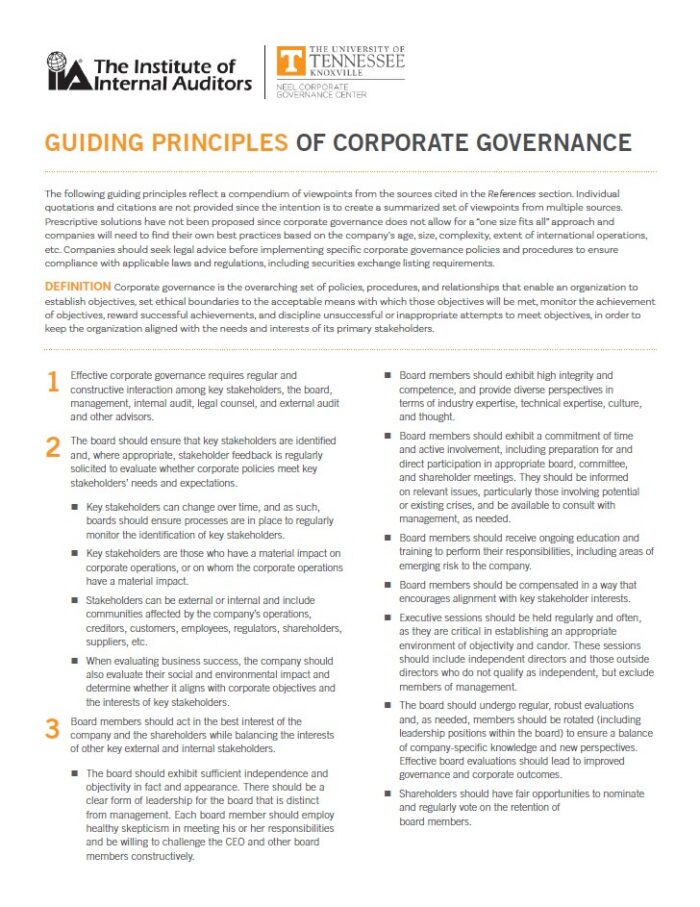
“Guiding Principles of Corporate Governance, 2018“
Corporate governance is the overarching set of policies, procedures and relationships that enable an organization to establish objectives, set ethical boundaries to the acceptable means with which those objectives will be met, monitor the achievement of objectives, reward successful achievements and discipline unsuccessful or inappropriate attempts to meet objectives to keep the organization aligned with the needs and interests of its primary stakeholders.
These eight principles focus on stakeholder engagement, board of director oversight, corporate culture, corporate disclosures and governance monitoring.

Neel Center and the Center for Audit Quality
“An Analysis of Alleged Auditor Deficiencies in SEC Fraud Investigations: 1998-2010, 2013“
This research examines 87 SEC investigations in which auditors were sanctioned in connection with alleged fraudulent financial reporting by U.S. public companies. Building on the earlier COSO study “Fraudulent Financial Reporting: 1998-2007,” the report identifies common audit deficiencies cited by the SEC and provides practical insights for strengthening audit quality and improving the detection of financial statement fraud.
The study highlights recurring themes in SEC enforcement actions, including failures to obtain sufficient audit evidence, exercise due professional care, maintain professional skepticism and appropriately assess and respond to fraud risks. The findings have helped inform the auditing profession, regulators, educators and corporate stakeholders by identifying opportunities to enhance auditor training, risk assessment, professional skepticism and audit execution to improve the prevention and detection of fraudulent financial reporting.
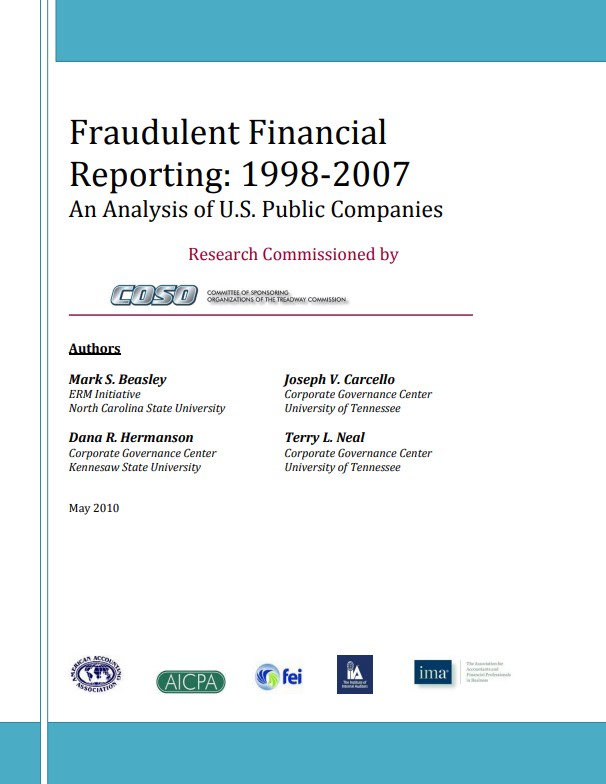
Neel Center and The Committee of Sponsoring Organizations of the Treadway Commision (COSO)
“Fraudulent Financial Reporting: 1998-2007 – An Analysis of U.S. Public Companies, 2010”
This research examines 347 cases of alleged fraudulent financial reporting investigated by the SEC between 1998 and 2007. Building on COSO’s earlier 1987-1997 study, the report analyzes trends in financial statement fraud, identifies common fraud techniques, examines the characteristics of companies and executives involved and evaluates the role of boards of directors, audit committees and external auditors in fraud prevention and detection.
The study provides important insights into the causes and consequences of fraudulent financial reporting, including the increasing magnitude of frauds, the prevalence of improper revenue recognition, the involvement of senior executives and the significant financial and governance consequences experienced by affected companies. The findings have informed regulators, investors, boards of directors, auditors and other stakeholders seeking to strengthen corporate governance and improve the prevention, deterrence and detection of financial reporting fraud.