Marty And Ann Brown 4 image From his years as an accounting student at the University of Tennessee, Knoxville, to his position as president and CEO of PYA, a nationally prominent accounting and consulting firm, Marty Brown (HCB, ’85) has achieved great success.
Yemisi Bolumole image A new world opened to Yemisi Bolumole when she was tasked with investigating how third-party logistics service providers might solve distribution issues.
“As we move from lower-income to higher-income areas, we don’t see a proportionate increase in lottery sales. Lower-income areas purchase a disproportionate amount of lottery tickets.”
"A decade ago, most supply chain leaders were focused on functional operational issues within their own areas of the supply chain such as procurement, logistics, or manufacturing operations. The C-suite was several managerial levels removed, making direct communication rare. Cost-cutting was often seen as the major value that supply chain could provide to the business."
“When there is demand, it comes in huge surges, but, of course, production doesn’t work that way. Production requires long, steady runs with plenty of setup time to get quality where it needs to be. Running big production batches leaves the manufacturers with product facing limited shelf life, ranging from 6 to 12 months, depending on the test type.”
“There’s empire building within organizations. People will say, ‘I have autonomy. I don’t want metrics on my list of key performance indicators that I don’t have direct control over.”
“The pandemic has honed the skills in collaboration. Some states and local governments have worked that more adeptly. Others are still working it out.”
“If you go over budget, people will be mad at you, but you’ll still have a job come Monday. And so the tendency is to make sure that we don’t stock out.”
Acree Family Faculty EndowmentMichael T. Crotty Graduate Business Scholarship EndowmentDHL Supply Chain Future Leaders ScholarshipDodd Family Graduate Fellowship EndowmentCharles P. & Dorothy N. Duggan Award EndowmentJoe Palmer, Bennie Palmer Johnson & Bill Johnson Business Scholarship EndowmentRyan Christian Knauss Memorial EndowmentLitfin Family Finance Faculty Award EndowmentMarvin W. & Jean P. Mills Memorial Business Scholarship EndowmentRasnic Bray Business Scholarship EndowmentRSM US LLP MAcc Fellowship EndowmentBrian Stevens Analytics Student of the Year EndowmentStephen & Nancy Underwood Accounting Scholarship Endowment
Your gifts are transformational.
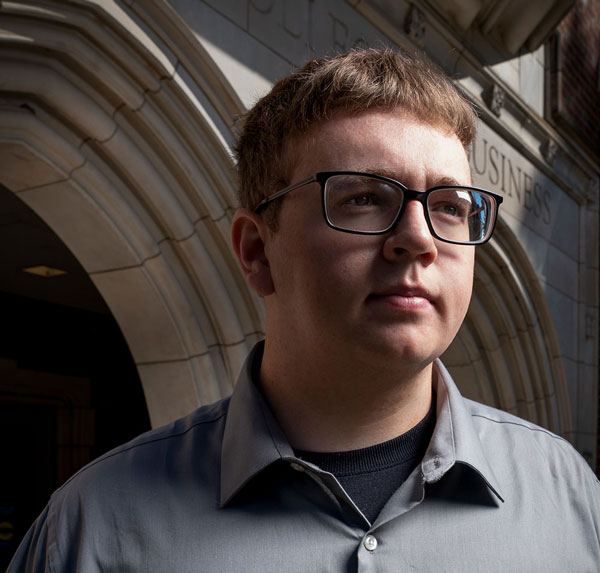
"I graduated from a small high school in rural West Tennessee. I was my class valedictorian and was involved in various organizations. Although other graduates at my school decided to attend small local colleges, I was convinced that attending a larger university would give me the opportunities and resources I needed to pursue a career. It is for this reason that I chose to attend the Haslam College of Business at UT. If it were not for donors like you, I would not be able to attend UT. Being a Volunteer these last two years has been the time of my life, and it has made me a more prepared and well-rounded individual.”
Supporting the College Fund supports students like Andrew.Haslam Fund


 Marty And Ann Brown 4 image From his years as an accounting student at the University of Tennessee, Knoxville, to his position as president and CEO of PYA, a nationally prominent accounting and consulting firm, Marty Brown (HCB, ’85) has achieved great success.