
Management
Project Management
Project Management at Haslam
Preparing Leaders Across Industries
The project management curriculum in the Department of Management and Entrepreneurship at the University of Tennessee, Knoxville, Haslam College of Business equips students with the critical skills and knowledge necessary to lead projects with confidence and effectively provide vital support in a business world marked by constant change.
Through a combination of theoretical foundations and practical application, Haslam’s project management program prepares graduates to oversee complex projects, optimize resources and deliver results that align with organizational goals.
Project management is necessary across industries, enabling professionals to oversee initiatives from inception to completion. Students in Haslam’s program gain hands-on experience in planning, executing and monitoring projects while developing leadership and problem-solving abilities. They also receive preparation for PMP® (for students with at least three years of project management experience) or CAPM® certification.
Program Highlights
- Comprehensive Curriculum – Courses cover essential topics such as project planning, risk management, resource allocation and stakeholder communication
- Real-World Applications – Engage in team-based projects to apply learning in practical settings
- Industry-Relevant Skills – Gain expertise with data-driven decision-making, Agile methodologies and in tools like Primavera
- Leadership Development – Build confidence directing cross-functional teams and driving project success through effective communication and collaboration
- Baseline Development: – Learn the key steps of baseline development such as work breakdown structures, scope documentation, estimating, scheduling and risk-based contingency development, as well as how baselines are used in proposal development and submittal
The PMI Talent Triangle®
Building Well-Rounded Professionals
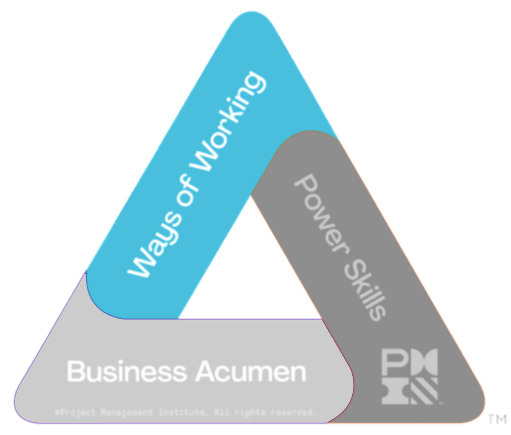
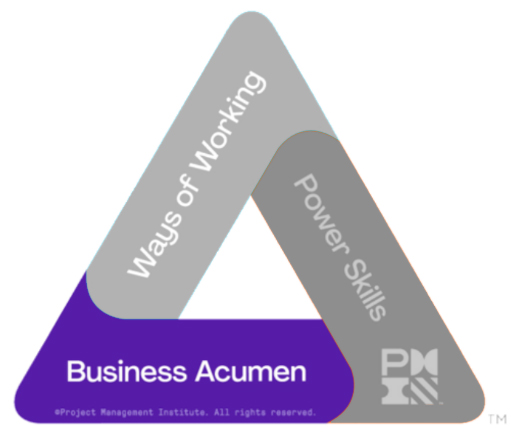
The PMI Talent Triangle® represents the blend of technical, leadership and business skills needed to succeed in any project-oriented career. Haslam’s project management courses prepare students to excel in all three areas of the triangle, regardless of career area.
How a Haslam Business College Management degree prepares students to be Project Managers
Ways of Working
(formerly Technical Projects Management)
How To Do Your Job
Focuses on the technical skills required to deliver today’s project. Project managers should analyze the project’s unique needs to determine which tools would be most effective to drive organizational results. Furthermore, they should proactively seek to expand their knowledge of project tools and techniques.
- Project management
- Advanced project management
- Managerial analytics
- Business communications
- Professional communications
- Supply Chain
Business Acumen
(formerly Strategic & Business Management)
How To Do Better At Your Job
This prioritizes the needs of the business by focusing on benefits, regulatory compliance, market awareness, and competitive analysis. These skills help the project manager understand how internal and external forces impact their project.
- Accounting
- Finance
- Economics
- Business software applications
- Organizational behavior
- Business ethics
- Business management
Power Skills
(formerly Leadership)
How To Help Others Achieve Their Goals
This area is all about personal leadership! It includes servant leadership concepts, communication, conflict management, coaching and mentoring, interpersonal skills, and problem-solving tools and techniques. The ability to create a compelling vision and motivate a skilled group of professionals to deliver on that vision is a strategic competency for leaders at all levels of the organization.
- Leadership skills
- Global strategic management
- Professional responsibility
- Legal environment of business
- Public speaking

Project Management
Career Outcomes
Ways of Working
Students develop strong technical and analytical foundations in scheduling, process optimization, project controls, and professional communication. They learn to use modern tools and frameworks like Agile and Waterfall, plus data-driven project analytics to manage projects efficiently across industries.
- Project manager (e.g., IT, construction, operations, marketing, finance)
- Project controls analyst/engineer
- Agile Project Coordinator/Scrum Master
- Implementation specialist (e.g., IT or Software)
- Operations or logistics planner
- Process improvement analyst
Power Skills
Project success depends on leadership, collaboration and influence. Students build interpersonal and emotional intelligence skills to lead teams, manage conflict and communicate effectively with diverse stakeholders essential in both in-person and virtual environments.
- Program or portfolio coordinator
- Team or product lead (e.g., IT, consulting or marketing)
- Operations manager/department supervisor
- Client engagement or customer success manager
- Change management specialist
- Organizational development or training lead
Business Acumen
Understanding the business context behind every project is key to aligning outcomes with strategy. Students gain foundational knowledge in accounting, finance, economics and organizational behavior, helping them think critically about value, cost and performance.
- Business analyst/systems analyst
- Strategy or management consultant
- Project controls engineer (e.g., engineering, energy, infrastructure)
- Product manager (e.g., tech/SaaS)
- Operations or supply chain analyst
- Entrepreneur/startup project lead
Industries Where Our Graduates Excel
Project management principles apply beyond traditional business. Halsam graduates have pursued successful careers in:
- IT and software development
- Construction and engineering
- Healthcare and research
- Supply chain management and manufacturing
- Finance and professional services
- Marketing, communications and nonprofits
MGT 380: Project Management
Course Spotlight
MGT 380 introduces students to the essential principles and practices of project management. Through simulations and real-world applications, students learn to define scope, manage resources, monitor performance and deliver successful outcomes.
The class is divided into teams of 5 members each. Team roles are Project Manager/Scope/WBS Manager, Business Analyst, Estimator/Project, Controller, Scheduler, Risk Manager. The project spans approximately 6 weeks. The objective is to create a Project Baseline for the Neyland Entertainment District Project and present it to a group of local project professionals in a ‘shark tank’ environment. Project elements include a pedestrian bridge, a hotel and at least 3 other venues for the top of G10.

Domain 1 Project Management Fundamentals and Core Concepts
- Project vs. operations.
- Project, program, and a portfolio.
- Predictive and adaptive approaches.
- Issues, risks, assumptions, and constraints.
- Scope, cost, quality, schedule
- Project Manager roles and responsibilities
- Management vs. leadership
- Project charters
- Project organization structures
- Project Management Office

Domain 2 Predictive, Plan-Based Methodologies
- Scope definition
- Work Breakdown Structures
- Cost estimating
- Scheduling
- Critical path, logic, resources, float
- Cost and schedule integration
- Performance Measurement Baseline
- Risk management
- Change control
- Earned Value Management
- Variance analysis

Domain 3 Agile Frameworks/Methodologies
- History of Agile
- Agile Manifesto
- Product roadmaps
- Release planning
- Sprint planning
- Product backlog management
- Daily scrum
- Role of the scrum master
- Sprint retrospective and review
- Themes, stories, and tasks

Domain 4 Business and Project Analysis
- Business analysis planning
- Stakeholder elicitation
- Monitoring and control
- Solution evaluation
- Return on Investment
- Internal Rate of Return
- Payback Period
- Requirements management
- Detailed schedule analysis
- Percent complete

Launch Your Career with Haslam Project Management
Graduates of Haslam’s project management program are prepared for roles across industries, from engineering and operations to consulting, finance and technology. Wherever they go, they bring the tools, leadership and business understanding to turn ideas into impact.