
Transformational Ties

A Landmark Gift
Group Of People StandingGroup Of People Standing image A landmark 2014 gift to the business school from three generations of the Haslam family fueled a transformation in undergraduate education, research, and experiences at the college that continues today. The $50 million gift not only created the Haslam College of Business, it helped to position it as a top-tier business school.

International Interrupted

Studying Abroad with Covid
Lady Sitting At TableLady Sitting At Table image On a train between the airport and the city, Emma Kreiss began to feel sick. “At first I was just really tired,” she says. “I remember leaning against a pole on the train and almost falling asleep.”

Thought Leadership

Wall Street Journal
"The spike in demand that came from a surge in online shopping flooded the United Parcel Service Inc. and FedEx Corp. delivery networks with shipments and allowed both companies to raise their shipping rates. Their stock prices soared after initially dipping as widespread lockdowns began in the early days of the pandemic. Yet changes in distribution strategies as a response threaten to loosen the carriers’ grip on the highly lucrative U.S. package-delivery market, and raise important questions about the business plans at the parcel carriers going forward that could have dramatic implications on how retailers get goods to their customers."

Alan Amling - Assistant Professor of Practice

Supply Chain Dive
"You saw what happened with PPE and the food supply chain. They broke because we didn't have that redundant inventory to buffer for these longer supply chains that we designed," Tate said.

Wendy Tate - McCormick Professor of Supply Chain Management, Ray & Joan Myatt Faculty Fellow

Commercial Appeal
COVID-19 vaccine distribution will put FedEx’s 'cold chain' to the test. Early in the pandemic, sudden demand spikes for #PPE & everyday items like toilet paper strained a lean global supply chain. This time, “there is no excuse for us failing,” Goldsby said.

Thomas Goldsby - Dee & Jimmy Haslam Chair of Supply Chain, David P. Perrot Supply Chain Management Faculty Fellow

The Atlantic
“The solution has to be us,” Wanamaker said, “and how we treat people and understand people and love people, and how we interact with them in society. That’s a huge challenge. But it’s not government’s to solve.”

Marianne Wanamaker - Professor of Economics and Dean of the Baker School of Public Policy and Public Affairs

Supply Chain Management Review
"You know HPO when you’re in one, because a culture of coordination and results exceeding expectations come by rote."

Michael Burnette - Fellow, Global Supply Chain Institute

Wall Street Journal
The dramatic shift of millions of Americans to remote work has allowed many companies to maintain operations under the enormous strain of the Covid-19 pandemic, but it has also opened them up to a wider range of cyber threats.

Ted Stank - Harry J. & Vivienne R. Bruce Chair of Excellence

New Faculty

Haslam proudly welcomed these 14 new faculty members in September 2020. For a more in-depth look at each faculty member's unique skill set and interests, follow the link below.

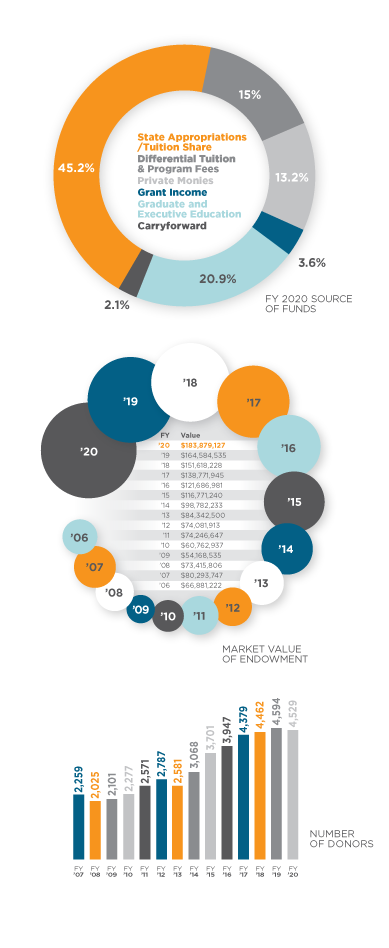
Sources of Funds

Source of Funds Market Value Donors Graphics

During a year of unprecedented change and hardship, the impacts of COVID-19 required innovative thought and action. We stayed the course and continued to provide the student focused academic support our students expect through the online platform of Zoom, as well as many small face-to-face interactions. This was year three of the “25 in 5” faculty hiring plan. We successfully onboarded many new faculty in August. The Graduate and Executive Education team persisted through all the challenges related to COVID-19 and continued to make positive impacts on our community by offering many of the traditional face-to-face courses in an online classroom. The revenues continue to grow and be reinvested into the infrastructure and support of our student experience. Private philanthropy remains an important funding source allowing the college to implement new programming, expand current offerings and support our students in their time here at the Haslam College of Business. Increasing private philanthropy, launching successful new programs that attract additional students and controlling our costs are always important, and particularly so as we strive to slow the increase in tuition levels given the economic realities facing our students and their families.